Kirill Marchenko is in trade rumors, so I pulled his page up on The Whiteboard to see what my own data says he is.
Everything below comes from my model, built from nightly NHL play by play. One note on reading it: ratings and tags are measured from last season's shifts, while team labels are current rosters.
The card
Marchenko grades as a Strong driver in the 82nd percentile among forwards, and my model classifies him as an offensive player. That is a very good rating. It is not a top ten right wing rating, and he is not on my top ten list at the position.
Underneath it sit two numbers most people will skip. Competition faced: 79th percentile. Teammates: 98th percentile. Both are measured from who was actually on the ice with him and against him, shift by shift. He drew hard matchups and he had the best teammate support in the league while doing it. The model already accounts for both in the 82, so the rating is honest. What it tells a buyer is that this season came out of close to an ideal environment, and he has never been asked to carry a line by himself.
What the numbers say
Across 1,110 minutes of 5 on 5 ice in 76 games, Marchenko finished in the league's top ten percent in goals with 17, shots on goal with 141, expected goals at 16.9, high danger shots with 26, and takeaways with 40. His primary and secondary assists both land in the top quarter, and his on ice shot share is 52 percent.
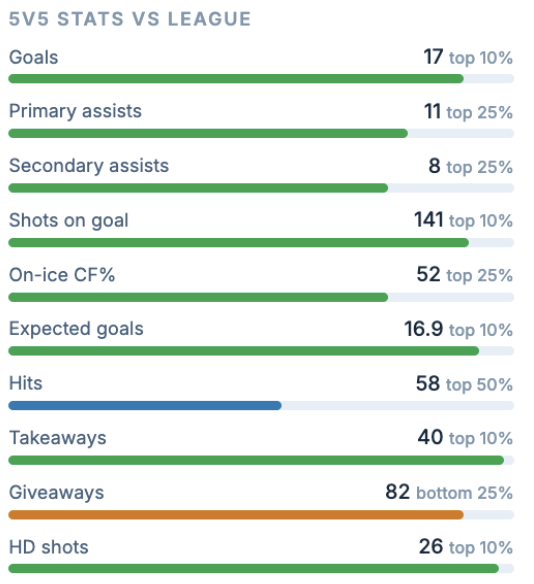
Two things stand out. The 17 goals came on 16.9 expected goals, so the finishing is backed by real chances rather than a hot stretch. And 40 takeaways is a rare number for a winger.
The one red mark on his page is giveaways. He had 82, bottom quarter of the league. A player who carries the puck this much will cough it up, and my model does not hide it.
The tags, and the shape they make
Marchenko earned eight tags, all Strong. My model writes its own definitions.
- Trigger man. Buries chances at a rate well above what his shots deserve.
- Green light. Shoots on sight. The attempt volume is real even when the shot does not get through.
- Rush threat. Most dangerous in the first few seconds after the puck turns up ice.
- Zone entry threat. Carries the puck in with control, and entries that start clean end in chances more often.
- Turnaround. Steals pucks in the neutral zone and attacks the other way before anyone resets.
- Stick thief. Takes pucks away at a real rate.
- Dual threat. Scores and sets up. Standout at neither, real at both.
- Secondary scorer. Chips in real goals without headline rates.
Notice what is missing. There is no Play driver tag and no Suppressor. My model does not see the engine of a line. It sees a transition player who finishes, steals pucks, and turns defense into offense in a hurry.
My chemistry model agrees and is blunt about it. The Plays Well With list on his page reads Playmaker, Puck driver, Distributor, Net front, Breakout QB, Play driver, Sniper, Two-way player. Every one of those either gets him the puck or covers for him. He is the payoff, not the setup.
Which teams actually need a right wing
I sorted every roster by the best right wing it has. These three are the thinnest.
| Team | Best RW | Next two |
|---|---|---|
| Edmonton | Matt Savoie, 48 | Kapanen 33, Frederic 11 |
| Montreal | Juraj Slafkovsky, 50 | Demidov 37, Anderson 23 |
| Seattle | Jordan Eberle, 56 | Kakko 23, Catton 23 |
This goes by listed position, and teams solve it by sliding a left shot winger over. Montreal has Cole Caufield at 85 and Edmonton has Zach Hyman at 85, both on the left. What the table measures is natural right wing quality.
Who should go get him
Edmonton is the fit my data likes most, and nobody is talking about it. Thinnest natural right side in the league, and they have exactly what his chemistry page asks for. Connor McDavid and Leon Draisaitl rate 99 and 98 and are the definition of the Play driver and Playmaker tags he pairs with. Put a Trigger man with top ten percent finishing next to either one and you are using him as designed. Whether the money fits is a cap question, not a hockey one.
Montreal is the cleanest realistic fit. Slafkovsky at 50 is their best right wing, so Marchenko at 82 is an immediate upgrade, and they can feed him properly. Nick Suzuki and Phillip Danault both rate 80 down the middle, Caufield is 85 on the left, Lane Hutson 79 on the back end. Given his teammate number, landing somewhere that does not downgrade his support matters more for him than for most players.
Seattle has the need and the wrong room. Eberle at 56 and then two 23s is as thin as it gets. But outside Mackie Samoskevich at 88 and Jared McCann at 73 there is nobody to drive his line, and a finisher without an engine is an expensive way to find out what that teammate number was telling you.
What Columbus should want back
The harder question is whether Columbus should do this at all.
Jet Greaves is the top rated goaltender in my goalie model. Werenski at 97 and Damon Severson at 92 is a real top pair. Down the middle they have Charlie Coyle at 84, Sean Monahan at 81 and Adam Fantilli at 63. That is a spine you add to.
They also just added Valeri Nichushkin, who rates 96 and earned it in Colorado without ever playing a shift with Marchenko. I suspect that addition is exactly why they feel they can move him. The problem is it swaps a winger for a winger and leaves the same cliff behind. Take Marchenko out and the wing group is Nichushkin, then Dmitri Voronkov at 65 and Mathieu Olivier at 64, then Conor Garland at 46, Cole Sillinger at 42, Kent Johnson at 19 and Miles Wood at 10. The third defense pair is the other soft spot, with Jake Christiansen at 5 and Erik Gudbranson at 2.
So the return cannot be futures. Columbus needs a top six winger who plays next October and a defenseman who can handle a real third pair. A prospect two years out makes a playoff roster worse while their goalie and their top pair are in their prime.
The short version
Marchenko is a very good hockey player. Top ten percent of the league in goals, shots, expected goals and takeaways, tagged as a finisher and a transition threat rather than a driver, and he did it with the best teammate support in the league.
Buy him as the finisher on a line that already has an engine and you are getting a weapon. Buy him expecting him to be the engine and you are paying for a player my data does not say he is.
All ratings, tags, and chemistry pairings from The Whiteboard, a free NHL line building tool I built. Every player is rated and tagged from nightly play by play data. Build your own lines at lastchangehockey.com.